


1 Kings 17:7-19
Who is Elijah? We are hearing about him this week in the readings of the holy Mass.
This is a wonderful question, especially for someone drawn to Carmelite spirituality. To understand you really need to read about Elijah.
Elijah's Place in Salvation History appears suddenly in the Bible during one of Israel's darkest spiritual periods. His story is found primarily in the books of 1 Kings and 2 Kings (chapters 17–19 and the opening chapters of 2 Kings).
The kingdom of Israel had fallen into widespread idolatry. King Ahab and Queen Jezebel promoted the worship of Baal, a pagan fertility god. Many Israelites abandoned the covenant with God.
Into this crisis stepped Elijah.
His name itself summarizes his mission:
"Elijah" (Hebrew: Eliyahu) means: "My God is Yahweh."
His entire life would become a testimony to that truth.
1. Elijah's Calling: The Prophet Appears
The first thing Elijah says in Scripture is:
"As the LORD, the God of Israel, lives, before whom I stand..." (1 Kings 17:1)
Notice that phrase:
"Before whom I stand."
This becomes central to Carmelite spirituality.
Elijah sees himself first as one who stands in God's presence.
Not primarily a preacher.
Not primarily a miracle worker.
Not primarily a reformer.
But a man who lives continually before God.
After announcing God's judgment—a drought upon the land—Elijah is sent into solitude.
2. Elijah at the Brook Cherith
God sends Elijah into the wilderness.
There he lives in isolation beside the Brook Cherith.
God feeds him through ravens.
This period teaches him:
dependence on God
silence
solitude
prayer
trust
For Carmelites, this resembles the contemplative life.
Before Elijah can speak for God, he must first listen to God.
3. The Widow of Zarephath
This is the reading you encountered yesterday at holy Mass. God sends Elijah to the town of Zarephath in Sidon.
There he meets a widow gathering sticks.
She possesses only:
a handful of flour
a little oil
enough for one final meal
Then she expects death from starvation.
Elijah asks her to feed him first.
Humanly speaking, it seems unreasonable.
Yet she obeys.
God responds with a miracle:
the flour never runs out
the oil never fails
The widow learns that God's providence is greater than visible resources.
Later her son dies.
Elijah prays over the child.
The child is restored to life.
This is one of the first resurrections recorded in Scripture.
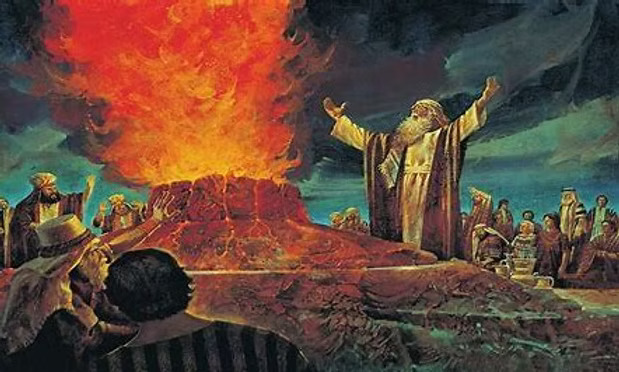
4. Today at holy Mass we hear about Mount Carmel: The Great Contest
This is the most famous event in Elijah's life.
Israel has largely embraced Baal worship.
Elijah challenges 450 prophets of Baal on Mount Carmel.
He asks the people:
"How long will you straddle the issue? If the LORD is God, follow him."
Two sacrifices are prepared.
The prophets of Baal call upon their god.
Nothing happens.
They shout.
Dance.
Pray.
Cut themselves.
Still nothing.
Elijah then drenches his sacrifice with water.
He prays a simple prayer.
God sends fire from heaven.
The people fall to the ground crying:
"The LORD is God!"
This becomes one of the defining moments of biblical faith.
For Carmelites, Mount Carmel is not merely a location.
It is the symbol of:
radical fidelity
prayer
spiritual warfare
total commitment to God
5. Elijah's Dark Night
Immediately after his greatest victory, Elijah collapses spiritually.
Jezebel vows to kill him.
Elijah flees into the desert.
He becomes exhausted and discouraged.
He prays:
"Enough, LORD! Take my life."
This is important.
The great prophet experiences fear, loneliness, and despair.
God does not rebuke him.
Instead God gives him:
sleep
food
rest
Then Elijah journeys forty days to Mount Horeb (Sinai).
This episode has often resonated deeply with Carmelites because it shows that even saints experience profound spiritual trials.
6. The Still Small Voice
This is perhaps the most important passage for Carmelite spirituality.
At Horeb Elijah encounters:
a mighty wind
an earthquake
a fire
But God is not in them.
Then comes:
"a tiny whispering sound"
or
"a still small voice."
God reveals Himself in silence.
Elijah covers his face.
He recognizes God's presence.
For Carmelites this is foundational.
God is not usually encountered through noise, excitement, or constant activity.
He is encountered in interior silence and loving attention.
Centuries later Carmelite saints such as Teresa of Ávila, John of the Cross, Thérèse of Lisieux, and Elizabeth of the Trinity would develop this same insight.
7. Elijah Forms Disciples
Elijah is not a lone mystic.
He forms spiritual sons.
Most importantly, he calls Elisha.
Elisha leaves everything and follows him.
The relationship resembles later patterns of spiritual fatherhood and discipleship.
Elijah's spirit continues through another generation.
8. Elijah Taken Up to Heaven
At the end of his earthly life, Elijah crosses the Jordan with Elisha.
A fiery chariot appears.
Elijah is taken into heaven in a whirlwind.
Unlike most biblical figures, Elijah never experiences an ordinary death.
This extraordinary departure leaves a profound impression on Israel.
His mantle falls to Elisha, symbolizing the passing of spiritual authority.
9. Elijah's Return in Jewish Expectation
Because Elijah never died, Jewish tradition expected his return before the coming of the Messiah.
The prophet Malachi foretold:
"I will send you Elijah the prophet before the great and terrible day of the LORD."
This expectation remained alive for centuries.
10. Elijah in the New Testament
Elijah appears throughout the Gospels.
Many wonder whether John the Baptist is Elijah returned.
Jesus explains that John came in the spirit and power of Elijah.
Most dramatically, Elijah appears with Moses during the Transfiguration of Jesus.
There Elijah speaks with Jesus on the mountain.
The Church sees this as confirmation of Elijah's unique role in salvation history.
Why the Carmelites Chose Elijah?
The first Carmelites absolutely followed Jesus Christ.
They were not choosing Elijah instead of Jesus.
Rather, they believed Elijah embodied a way of following God that prepared perfectly for the Gospel.
Around the late 12th century, Christian hermits settled on Mount Carmel.
Why there?
Because tradition held that Elijah had prayed and lived there.
These hermits wanted to imitate:
Elijah's contemplative prayer
His life revolved around God.
Elijah's solitude
He often dwelt in wilderness and silence.
Elijah's obedience
He followed God's commands immediately.
Elijah's zeal
Their motto eventually became:
"With zeal have I been zealous for the Lord God of Hosts."
(1 Kings 19:10)
Elijah's experience of God
Especially his encounter with God in the gentle whisper.
Elijah's life "before God's face"
The Carmelite ideal is continual awareness of God's presence.
This comes directly from Elijah's words:
"The LORD lives, before whom I stand."
Elijah and the Carmelite Understanding of Prayer
If one sentence summarizes Elijah's importance, it is this:
Elijah teaches that the deepest work of God's servant is to live continually in God's presence.
The Carmelites saw in him:
the contemplative
the prophet
the solitary
the disciple
the man of prayer
the lover of God's glory
Then they looked to Jesus, who fulfilled perfectly everything Elijah pointed toward.
Elijah became their spiritual father because his life already contained many of the elements that Christ would later perfect in the Gospel.
Elijah is not merely a prophet from the past.
He is the biblical model of a soul consumed by God, listening in silence, trusting completely, and standing always in the presence of the Lord. That is why, more than eight centuries after those first hermits gathered on Mount Carmel, Elijah remains at the heart of Carmelite spirituality.
"Jesus, We Trust in You!"